Before the Bronx, There Was Kingston: The Caribbean Roots Hip-Hop Doesn't Talk About
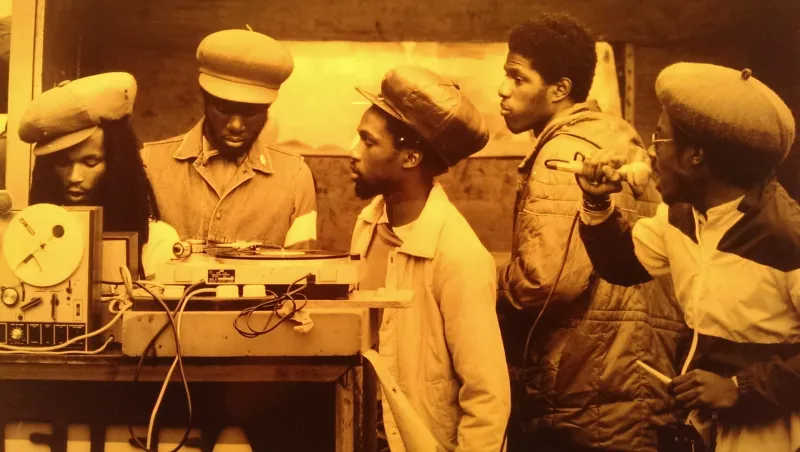
Photo: vintage Jamaican sound system DJ turntable 1970s music culture, via louderthanwar.com
Every culture has a creation myth. For hip-hop, it goes something like this: August 11, 1973, a rec room in the South Bronx, a teenager named Clive Campbell — better known as DJ Kool Herc — throws a back-to-school party and, in the process, invents a genre. It's a great story. It's also only half the picture.
Because Clive Campbell wasn't just some kid from the Bronx. He was born in Kingston, Jamaica. And the techniques he brought to that turntable? He didn't dream them up in a New York apartment. He'd watched them being practiced his whole childhood, in the yards and streets of a city that had already been perfecting this exact art form for decades.
That's the side of the story that rarely makes the documentary cut.
Kingston Was Doing This First
By the 1950s, Jamaica had developed a thriving sound system culture that was, in every meaningful sense, a precursor to what we now call DJing. Operators like Duke Reid — a former police officer who moonlighted as a dancehall kingpin — and Clement "Coxsone" Dodd were running mobile sound rigs that traveled across Kingston, setting up in open yards and community spaces to throw massive outdoor parties.
These weren't just guys pressing play on a record. They were curators, competitors, and showmen. Sound system operators would travel to the US specifically to dig for exclusive records — obscure American R&B cuts that no one else in Jamaica had. Owning a track nobody else could play was currency. It meant your crowd was bigger, your reputation was louder, your system was the one people walked miles to reach.
To protect those exclusive finds, operators would scratch the labels off records so rivals couldn't identify them. Think about that for a second. The concept of exclusivity in DJ culture, the hustle of crate-digging, the competitive one-upmanship between sound systems — all of it was alive and kicking in Kingston before most Americans had ever heard the word "turntable."
The Man in the Middle
Then there was the selector and, crucially, the toaster. While the selector chose and played the records, the toaster was the person who talked over them — hyping the crowd, calling out names, weaving improvised rhymes into the music. These were called "toasts," and figures like U-Roy and Big Youth turned the practice into an art form in the late 1960s and early '70s.
Listen to U-Roy's vocal runs over a riddim track and then go listen to early hip-hop MCs. The lineage isn't subtle. The cadence, the crowd engagement, the way the voice becomes another instrument layered over the beat — it's the same DNA.
When Herc set up those speakers in the Bronx, he brought this entire philosophy with him. His innovation — the "Merry-Go-Round" technique, isolating and looping the percussion break of a funk record — was genuinely new. But the framework around it? The idea of the DJ as a community anchor, the MC as a hype presence, the party as a cultural statement? That came straight from Kingston.
Why the Credit Never Followed
So why doesn't the mainstream version of hip-hop history lead with Jamaica? A few reasons, and none of them are particularly flattering.
Part of it is the way American popular culture tends to domesticate things. Once a sound becomes commercially viable in the US, its foreign origins get smoothed over. It becomes "ours." Rhythm and blues, rock and roll, jazz — American music has a long habit of absorbing influences from Black and immigrant communities and then repackaging them with a cleaner, more marketable origin story.
Part of it is also about who gets to tell the story. The record labels, the journalists, the documentarians who shaped hip-hop's public narrative in the 1980s and '90s were largely focused on the Bronx, Brooklyn, and Harlem. The Caribbean immigrant experience — already marginalized within Black American communities at the time — wasn't a perspective that got much airtime.
And part of it, honestly, is that hip-hop's founding figures didn't always volunteer the connection. Not out of dishonesty, but because the culture they built in New York was genuinely its own thing. It had absorbed the Jamaican influence and transformed it through the specific pressure of South Bronx life in the 1970s — the poverty, the gang culture, the city's near-total abandonment of its poorest neighborhoods. What emerged was something new. Claiming that newness made sense.
But new doesn't mean rootless.
The Broader Caribbean Fingerprint
Herc wasn't alone in carrying these influences north. Grandmaster Flash, one of the other architects of early hip-hop, has spoken about the Caribbean rhythms and sensibilities that ran through his community in the Bronx. DJ Kool Herc's early parties explicitly borrowed the sound system format — massive speaker towers, an emphasis on bass that you felt in your chest, a communal outdoor energy that was more Kingston yard than New York nightclub.
Even the fashion and language of early hip-hop carried Caribbean traces. Certain slang terms, styles of dress, ways of commanding a crowd — the cultural cross-pollination was constant, even when it was unacknowledged.
More recently, the rise of dancehall's influence on hip-hop has become impossible to ignore. Artists like Drake have worn the connection openly. But even that contemporary acknowledgment tends to frame it as a new relationship rather than a very old one finally becoming visible again.
Giving Credit Where It's Due
None of this is meant to diminish what hip-hop became in New York, or what the Bronx gave the world. The genre that grew out of those block parties went on to become arguably the most globally influential musical form of the last fifty years. That's an extraordinary legacy, and it belongs to the communities that built it.
But legacies are richer when they're told fully. Duke Reid and Coxsone Dodd deserve to be in the hip-hop conversation. U-Roy deserves a mention alongside the first MCs. The Jamaican immigrants who carried a musical philosophy across the Caribbean Sea and planted it in the concrete of the South Bronx deserve more than a footnote.
The side story of hip-hop isn't a challenge to the main one. It's what makes the main one make sense.
History has a way of tidying up the messy, beautiful truth of how cultures actually borrow from each other, argue with each other, and ultimately build something neither could have made alone. Hip-hop is one of the most stunning examples of that process in modern memory.
It just deserves the full story.