They Read the Sky in Numbers Long Before Galileo Picked Up a Lens
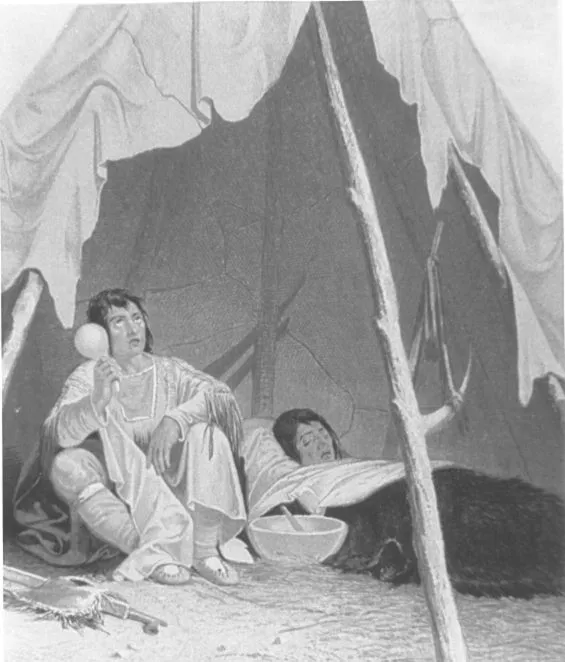
Photo: Captain Samual Eastman, Public domain, via Wikimedia Commons
There's a certain kind of arrogance baked into the way Western science tells its own origin story. It goes something like this: a handful of Europeans squinted at the heavens, scratched some numbers onto parchment, and — boom — astronomy was born. Everyone else was just... looking up and guessing.
Except that's not what happened. Not even close.
Long before Copernicus rearranged the solar system on paper, Indigenous peoples across North America had already built sophisticated systems for tracking celestial movement, calculating agricultural cycles, and navigating thousands of miles of open land and ocean using nothing but the sky overhead. They didn't just observe the stars. They mathematized them. And when European colonizers arrived and eventually formalized what we now call modern science, a lot of that foundational knowledge got absorbed, renamed, and quietly credited to someone else.
Chaco Canyon Wasn't Just a Settlement — It Was an Observatory
Let's start in the high desert of what is now New Mexico. The Ancestral Puebloans who built Chaco Canyon between roughly 850 and 1150 CE weren't just constructing a city — they were engineering a precision instrument on an architectural scale.
The great houses of Chaco are aligned with remarkable accuracy to solar and lunar cycles. Pueblo Bonito, the largest of the structures, has walls oriented to within a fraction of a degree of true north-south. Specific doorways and windows were positioned to frame the rising sun on the summer solstice. Researchers have documented a network of roads radiating outward from the canyon that align with cardinal directions in ways that couldn't have been accidental.
Then there's the Sun Dagger site on Fajada Butte — a spiral petroglyph that, through the movement of light between three large stone slabs, marks the solstices and equinoxes with near-perfect accuracy. It's a calendar carved into a cliff face, operating on principles of shadow geometry that require serious mathematical understanding to design intentionally.
When archaeologists first began studying Chaco in the 19th and early 20th centuries, the dominant framework was one of "primitive complexity" — the idea that these structures were impressive but essentially accidental, the product of intuition rather than calculation. It took decades of pushback from Indigenous scholars and a handful of open-minded archaeoastronomers to get the academic establishment to admit what Puebloan communities had always known: their ancestors were doing astronomy. Real astronomy. The kind that requires abstract thinking, generational data collection, and mathematical reasoning.
Pacific Northwest Peoples and the Geometry of the Sea
Shift west to the Pacific coastline, and the story gets even more layered. Coastal Indigenous nations from present-day Northern California up through British Columbia developed navigational knowledge systems that allowed them to travel open ocean routes with a reliability that still impresses modern maritime scholars.
The Haida, the Tlingit, the Makah — these weren't peoples who hugged the shoreline out of caution. They were deep-water navigators who used star positions, wave patterns, and current behavior in combination to build what amount to mental charts of the Pacific. The mathematical relationships between stellar positions and geographic location that underpin this kind of navigation are the same relationships that European sailors were desperately trying to formalize through instruments like the sextant centuries later.
What's particularly striking is how this knowledge was encoded. It wasn't written in the Western sense, but it was absolutely recorded — in oral traditions, in the structure of ceremonial practices, in the design of tools and vessels. Information storage doesn't require paper. It requires system. And these were systematic people.
When "Primitive Observation" Is Just a Polite Way of Saying Theft
Here's where the story gets uncomfortable, and also where The Side Story lives — in the gap between what actually happened and what the official record says.
As European-descended scientists began cataloguing the natural world of North America in the 18th and 19th centuries, they frequently relied on Indigenous knowledge to do it. Botanical knowledge, ecological knowledge, geographical knowledge — and yes, astronomical and calendrical knowledge — were all extracted through a mixture of observation, forced interaction, and outright appropriation.
The pattern was consistent: Indigenous knowledge would inform European scientific conclusions, those conclusions would be published under European names, and the source would be described in terms like "local custom" or "native legend" if it was mentioned at all. The knowledge got laundered through the credentialing system of Western academia and came out the other side looking like an original discovery.
This isn't a fringe critique. It's increasingly well-documented. Ethnobotanist Gary Paul Nabhan has written extensively about how agricultural knowledge developed by Indigenous peoples of the Southwest was adopted wholesale by American farming science. Similar dynamics played out in astronomy. The ceremonial calendars of numerous Plains nations, for instance, incorporated Venus cycle tracking with an accuracy that matched what European astronomers were independently working toward — but the Plains nations had been doing it for generations before contact.
The Fight to Put the Names Back
The good news — and there is some — is that a growing number of Indigenous scholars, scientists, and community advocates are refusing to let this erasure stand.
Fields like cultural astronomy and ethnoastronomy have gained real traction in the last two decades, with researchers working to document, analyze, and formally recognize Indigenous astronomical traditions on their own terms. Organizations like the Native Skywatchers program, founded by Anishinaabe and Dakota educator Annette Lee, are doing the dual work of preserving these knowledge systems and making them accessible to new generations of Native students who deserve to see their ancestors reflected in the story of science.
There's also a growing conversation happening inside universities — slow, sometimes frustrating, but real — about how science curricula tell the story of human knowledge. When astronomy textbooks start in ancient Greece and skip to Renaissance Europe, they're not just being incomplete. They're actively constructing a narrative that serves a particular worldview. Decolonizing science education means asking hard questions about whose contributions get counted and why.
Some institutions are starting to listen. The University of Hawaii has collaborated with Native Hawaiian navigational experts to formally document wayfinding knowledge. Several Southwestern universities have developed partnerships with Puebloan communities to study archaeoastronomical sites in ways that center Indigenous interpretation rather than overriding it.
The Stars Don't Care About Credentials
Here's the thing about the cosmos: it doesn't issue PhDs. The stars moved in predictable, mathematically describable patterns for Indigenous astronomers exactly the same way they did for Tycho Brahe. The knowledge was real. The math worked. The calendars functioned. Crops were planted at the right time, voyages were completed successfully, ceremonies aligned with celestial events across generations.
The question was never whether Indigenous peoples understood the sky. The question — the one we're still answering — is why we spent so long pretending they didn't, and who benefited from that pretense.
The side story here isn't really a side story at all. It's the foundation. And it's about time the history books got their architecture right.